
Uranus Lies on Its Side
Hello, friends and parents! Did you know that all the planets in our Solar System revolve around the Sun and also spin on their axis like a toy top? But there is one planet, Uranus, that does this in a very unusual way – it is as if it is lying on its side! Imagine a spinning top spinning not upright, but lying down. Why is Uranus so "special"? Let's find out!
What does "lying on its side" mean?

Most planets (Earth, Mars, Jupiter) rotate on their axis almost "vertically", meaning their rotational axis is almost perpendicular to the plane in which they orbit the Sun. However, Uranus's axis of rotation is tilted by almost 98 degrees! This means that it sort of "rolls" along its orbit around the Sun, rather than spinning while standing "upright".
The Main Theory:

An ancient collision! The most popular and scientifically based theory explains this by a powerful collision. Scientists believe that a very, very long time ago, when the Solar System was just forming, one or more very large objects the size of Earth or even larger crashed into Uranus. This powerful impact "knocked" the planet onto its side.
When could this have happened?
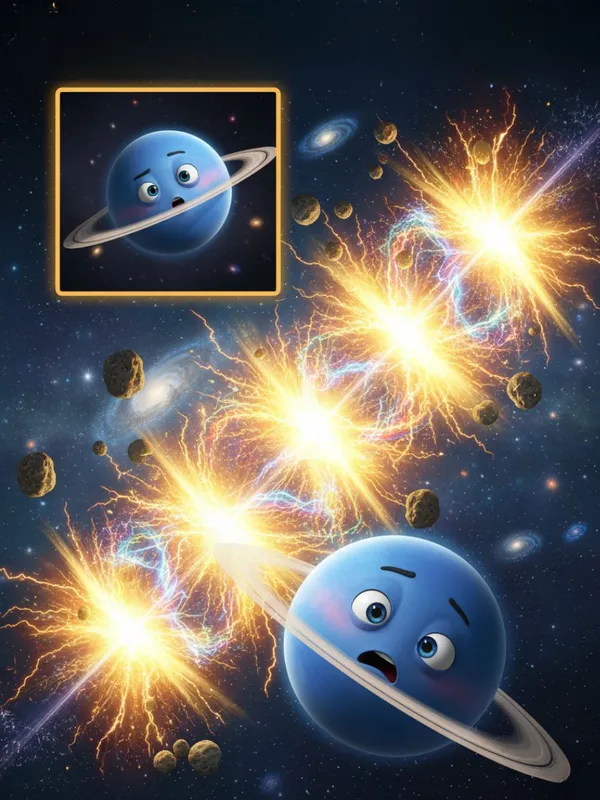
At the dawn of the Solar System! It is assumed that this epic collision occurred billions of years ago, during the very earliest stages of the Solar System's formation. At that time, there were far more large asteroids and protoplanets flying around in space, and collisions were a much more frequent occurrence.
Other Versions:

Not just one impact, but several? Some scientists suggest that it might not have been a single hit, but several in a row. Perhaps several smaller objects crashed into Uranus, gradually tilting its axis. This would also help explain some of Uranus's other features, such as its strange magnetic field.
Consequences of Such a Tilt:

Very long seasons! The fact that Uranus lies on its side has a huge impact on its "weather". Earth has spring, summer, autumn, and winter. Uranus has seasons too, but they last a VERY long time – 21 years each! This is because one hemisphere can be lit by the Sun for 21 years in a row, while the other remains in complete darkness. And then they swap places.
Is Uranus Unique? Almost!
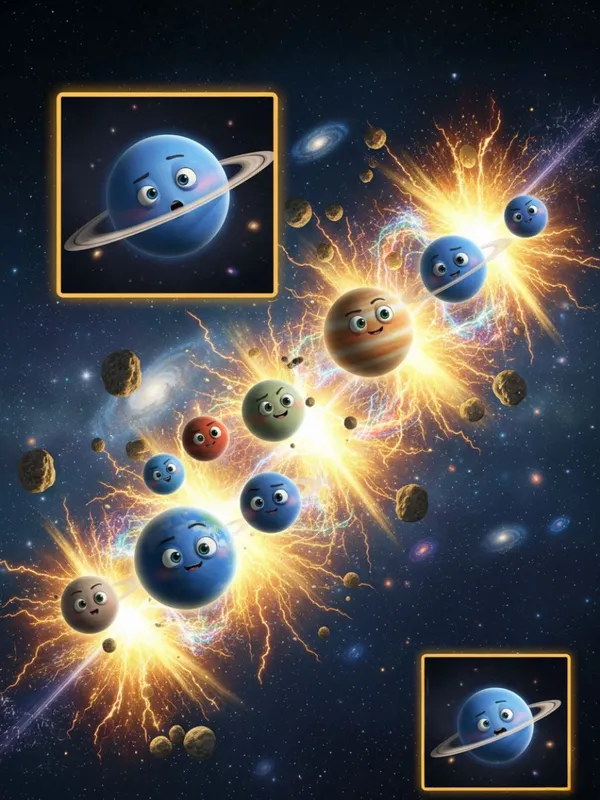
Uranus is the most "tilted" planet in the Solar System. Although other planets also have axial tilts, none are as extreme as this. This makes Uranus truly unique among our planetary neighbors.
How Do Scientists Study Uranus?

With telescopes and probes! Scientists study Uranus using powerful telescopes on Earth and spacecraft. For example, the Voyager 2 probe flew past Uranus in 1986 and sent back a wealth of valuable information about the planet and its unusual tilt.
Experiment for Kids: "The Tilted Planet"!

Want to understand how a planet can "lie on its side" while rotating? Let's do a simple experiment! What you will need:
- One round object (like a ball or globe) – this will be your "planet Uranus".
- A string or thin stick – this will be the "axis of rotation".
- A small open space (just in a room is fine).
What to Do:
Tie the string to the "planet" so that it passes through its "poles" (if it is a globe, this is easy; if it is a ball, you can just imagine it). Or glue the stick so that it sticks out from both sides. Hold the "planet" by the string (or stick) and try to spin it so that the axis is almost vertical (like Earth). This is regular rotation. Now tilt the string (or stick) so that it is almost horizontal, meaning the "planet" is lying on its side. Try spinning the "planet" in this position. You will see that it still rotates, but its "poles" now point to the sides rather than up and down. Now imagine a flashlight shining on your "planet" (this is the Sun). When your "planet" lies on its side and rotates, it will turn one side and then the other to the "Sun" for a very long time. This will help you understand why Uranus has such strange and long seasons. This experiment shows how much the tilt of the rotation axis can change our understanding of a planet's motion and how it receives light from a star.